Share:

Please enter a valid location
The ROI checklist: High yield potential, lower inputs, and higher return from the gin

Weeds and insects often top the list of major production challenges in cotton. But as farms grow in size, managing different soil types and agronomic conditions is critical for consistent, high yield potential.
For Alabama producer Shep Morris Jr., diverse agronomic conditions across his 4,300-acre operation is one of his biggest problems to solve when planting and managing cotton varieties.
“Throughout the Southeast, we have very unique microclimates and soil types, and the diversity on our farm means we don’t always have ideal conditions,” said Morris, who farms with his dad Shep Sr. and his mother Rite. “We’re trying to make high yields across many different soil types in dryland fields – this is challenging farming.”

On his Alabama farm with fields as diverse as a patchwork quilt, Shep Morris Jr. plants PhytoGen® brand varieties for their consistent performance and ability to “flex” across the dryland acres he farms with his dad Shep Sr. and mother Rite.
Morris has a typical Southeast mix of quick-draining sand and river bottom silt loam, but more than half of his acres are comprised of Black Belt soil, a distinct soil found in southern Alabama that’s often slow to drain. Field conditions across the farm are never uniform and continually change.
To succeed across diverse soil types, Morris plants PhytoGen® cottonseed for high yield potential in tough conditions that are often too dry, too wet, and then dry again – all in one season.
“The PhytoGen varieties we're growing are very resilient. Resilience is a good word to describe how they can flex and produce well across all these challenging environments,” Morris said. “The yield has been more consistent with the PhytoGen varieties. They’re producing more cotton – it’s that simple.”
Morris and his father have planted PhytoGen® brand varieties for more than 20 years, but they started planting 100% PhytoGen cottonseed in [insert year after confirmation]. Since making the switch, his yields have averaged 1,200 to 1,400 pounds per acre on dryland, higher than previous yields with competitive varieties. In 2025, he broke through those averages with PhytoGen® brand PHY 475 W3FE, averaging 1,600 pounds per acre on dryland. For the 2026 season, Morris planted most of his cotton acres to PhytoGen® brand PHY 357 W3FE, PHY 443 W3FE, and PHY 475 W3FE.
Plant health starts below the soil
One reason Morris believes PhytoGen brand varieties are so resilient is their healthy root systems protected by built-in root-knot and reniform nematode resistance. Although his nematode populations are not as high as some acres in the Southeast, moderate nematode populations can impact root growth, and the warning signs don’t show up until a drought hits. Then it’s too late.
Many growers like Morris have discovered that in-seed protection from nematodes isn’t just for acres with record-breaking populations. Moderate nematode populations can also impact yield, especially when plants suffer drought stress. Morris believes PhytoGen brand varieties with nematode resistance develop better root systems, helping plants uptake more water for higher yield averages across his diverse cotton acres.
“We don't have a horrible nematode problem because of our rotation to corn and sesame, but the reniform and root-knot nematode resistance in the PhytoGen varieties is a big help,” Morris said. “The PhytoGen varieties are able to pull nutrients and moisture from the soil where other brand varieties find it more challenging, especially in more stressful environments.”
Lower inputs, fiber premiums add up to higher ROI
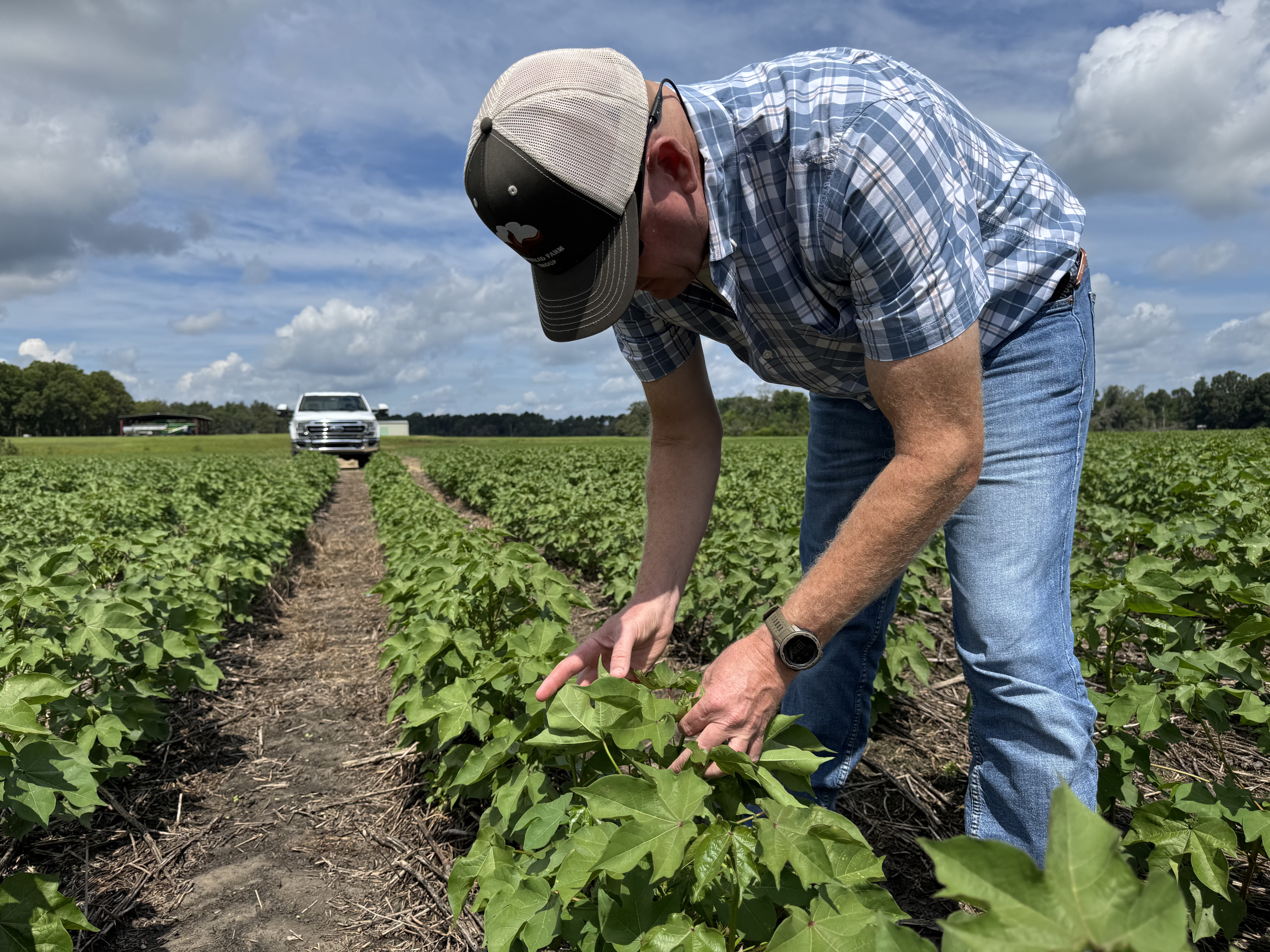
Shep Morris Jr. has increased average yields with PhytoGen® brand varieties because of their consistent performance across varying, tough conditions. He credits built-in resistance to root-knot and reniform nematodes for helping plants develop healthy root systems for better water and nutrient uptake.
Agronomic hurdles aren’t the only difficulties on his farm. Rising production costs and lower commodity prices have challenged farm economics in recent years. But Morris has gained an economic edge by reducing his seeding rates with the early season vigor of PhytoGen cottonseed.
His plant populations with competitive varieties were typically between 30,000 and 34,000 seed per acre. Now he’s planting 24,000 seed per acre with PhytoGen brand varieties – a 20% to 29% savings on seed. That lowers investment up front and helps his ROI at the end of the season.
“In the current economic environment, we’re trying to keep costs as low as possible. The emergence with PhytoGen cottonseed helps us get the crop up and out of the ground in cooler, wetter soils – even if there’s a bit of a crust,” Morris said. “We're not having to plant as much seed, and that's saving us money up front. And we're still making a great crop and yield.”
In addition to the savings at planting, Morris says PhytoGen brand varieties often earn extra profits at the gin – first from premiums for excellent fiber quality, and then with higher gin rebates due to the large-sized seed.
“We're seeing good fiber quality and getting a premium, often two to three cents per pound. At 80-cent cotton, that will increase your net profit by 3.5% just for having better quality,” Morris said. “We look for fiber quality premiums because otherwise you're going to have to make it up in yield. But if you can get both, that's even better. Then there's more seed for the gin to sell, which means a better rebate back to farmers.”
It all adds up to better economics, which allows Morris to keep doing what his father started in Macon County, Alabama, more than 50 years ago.
“I love cotton – it’s my favorite thing to grow. I like corn and sesame, but I love cotton. It's like an addiction I guess,” Morris said. “You go out there at the end of the year, and you see that white field. There's something about growing cotton. There's nothing else like it.”
To find PhytoGen brand varieties for your farm, go to PhytoGen.com/varieties.
™®Trademarks of Vylor and its affiliated companies. © 2026 Vylor. 01559 BR (9/26) 02031