Share:

Please enter a valid location
Mitigate Thrips Impact with Industry-leading Early Season Vigor
Thrips management in cotton begins at seed selection. With moderate to high pressure, thrips can cost growers as much as 400 to 660 lb/A1, and PhytoGen® cottonseed with industry-leading early season vigor helps plants reach the safe 4- to 5-leaf stage faster.
Key Points
- The risk: Moderate to high thrips pressure can cut yields by as much as 400 to 660 lb/A.1
- The window: Seedlings are most vulnerable in the first two weeks after emergence and are out of danger by the 5-leaf stage.
- The defense: Vigorous seedlings get past thrips sooner, which may protect yield and reduce postemergence thrips applications.
- The proof: PhytoGen® brand varieties held the top 7 emergence spots and 9 of the top 10 in the 2026 Oklahoma State irrigated OVT in Altus.
- The fit: Strong vigor lets growers plant into heavy cover crops, which also helps mitigate thrips damage. A Georgia cotton grower achieved 85% to 90% emergence while planting in an 8-way-mix rolled cover crop.
When evaluating cotton varieties after harvest, the threat of early season pests is often long forgotten in the season’s rearview mirror.
But thrips are costly yield-robbing insects across the Cotton Belt, and protection begins with selecting varieties with strong early season vigor. It’s a well-documented fact: thrips no longer threaten yields once cotton plants reach the 4- or 5-leaf stage. Vigorous emergence and growth get plants to that safe stage more quickly to mitigate damage, potentially protecting yield and reducing postemergence thrips applications. That’s a win for your ROI.
PhytoGen® cottonseed provides industry-leading emergence and early season vigor that serves as the first line of defense against thrips and early season disease.
An Annual Challenge (of Unpredictable Proportions)
Throughout much of the Cotton Belt, thrips are a seasonal pest – their arrival is not a matter of “if” but “when.” With moderate to high levels of thrips, University and Extension entomologists have estimated yield losses as high as 400 to 660 pounds/A.1
Thrips feed on young cotton plants, causing delayed maturity and uneven stands. Young cotton plants are more susceptible to yield-reducing injury from thrips during the first two weeks after emergence, especially during the 1- to 2-leaf stage in cotton development.2 Extension and agronomists confirm that thrips have little impact on yield at the 4-leaf stage, and cotton plants are no longer at risk when they reach the 5-leaf stage.
Seedlings with low vigor and slow growth are more susceptible to thrips injury.2 Slow-growing seedlings allow more time for thrips to feed before plants reach the 5-leaf stage, leaving the door open to increased yield loss. To protect against thrips damage, university entomologists recommend growers “promote rapid seedling growth to minimize these losses, through planting high-vigor seed.”3
The Early Season Vigor Advantage
PhytoGen Field Agronomist Brad Hopkins, Ph.D., said PhytoGen cottonseed offers excellent emergence and early season vigor to help establish fast-growing stands that can quickly push past the critical thrips-damage window. When you plant PhytoGen brand varieties, early season vigor is built into the seed – not a trait that comes at an additional price, so growers get high-yield potential and yield protection in the same varieties.
“One of the best ways to escape thrips damage is to outrun them – to get to the 4- or 5-leaf stage faster than the competition,” Hopkins said. “When you plant PhytoGen cottonseed, you close the gap faster against thrips, and you get that benefit with the high-yield potential of our industry-leading varieties.”
Many growers across the Cotton Belt use imidacloprid as a seed treatment or in-furrow at planting as a low-cost, proactive treatment for thrips. With excellent emergence and seedling vigor, PhytoGen brand varieties often limit the need further protection.
“Because PhytoGen brand varieties get to the fifth true leaf stage so quickly, often without significant thrips damage, many of our customers are able to get by with a single thrips application and sometimes none at all ,” Hopkins said. “With strong seedling vigor from PhytoGen, you may not need additional insecticide or trait protection against thrips. With warm soil and excellent early season vigor, our cottonseed varieties can often outgrow thrips.”
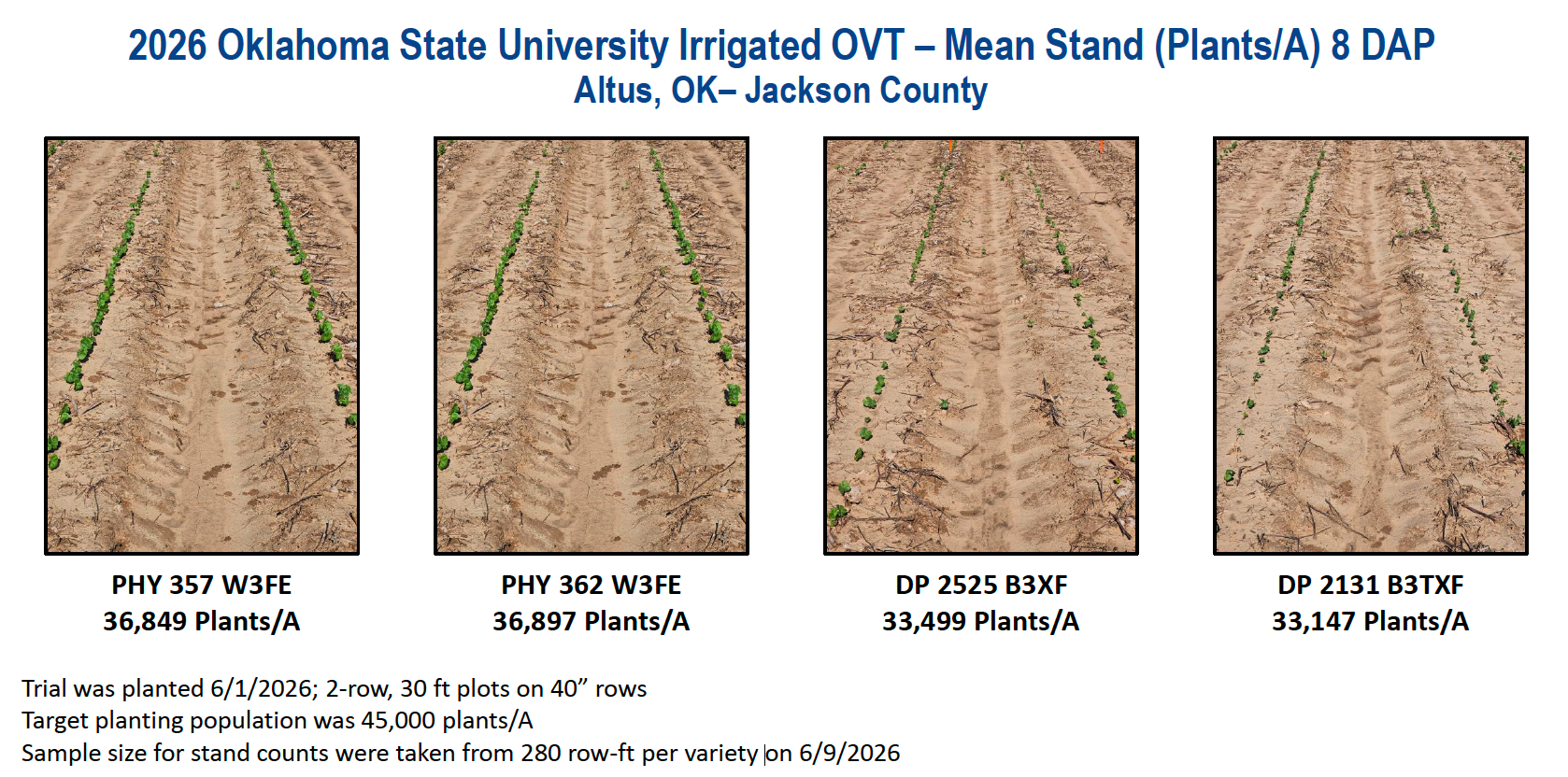
Hopkins has studied cotton emergence and plant vigor for the last six years, compiling data from the Texas A&M Monster Cotton Variety Trials in south Texas. In 2026, he studied at-plant vigor and emergence in the Oklahoma State University irrigated OVT in Altus, Oklahoma. In that trial, the top 7 varieties with the best emergence – and 9 of the top 10 – were PhytoGen brand varieties. In years of trial data, Hopkins said PhytoGen is head and shoulders above the competition when it comes to emergence and early season vigor.
“Year in and year out, PhytoGen has proven itself as the industry leader for emergence and early season vigor in these trials,” Hopkins said. “They confirm what we hear from our customers – PhytoGen is bar none the leader in emergence and early season vigor across the industry. Our varieties help set growers up for healthier stands and higher yield potential at harvest.”
Covering Your Bases
Another off-season decision that can mitigate thrips damage is the implementation of cover crops and reduced tillage. According to University of Georgia Extension, “Thrips infestations are significantly lower in reduced tillage production systems compared with conventional tillage. In general, the more cover or residue on the soil surface the greater the reduction in thrips.”2
Strong emergence and early season vigor enables growers to plant into heavier cover crops and still get a good stand. Georgia producer Josh McCormick plants 100% PhytoGen cottonseed into an 8-way cover crop mix that includes clover, rye, oats, and legumes. At planting, they roll down the cover crop and plant directly into it.
“PhytoGen has big seed with early season vigor that’s going to come up,” Josh said. “We see 85% to 90% emergence, and that’s coming up in the heavy residue of our rolled cover crop. I like to plant cottonseed fairly deep, and we don’t worry about getting a solid stand with the early season vigor of PhytoGen cottonseed.”
That cover crop helps with weeds, soil biomass, and fertility with the added benefit of improved thrips management. It adds up to better plant health to help plants push through seasonal challenges and toward the goal of a better harvest.
“When it comes to managing cotton against insects, early season vigor helps give plants an edge,” Hopkins said. “When plants are healthier during the critical first 40 days, they are more likely to capture higher yield potential.”
1Managing Thrips in Cotton: Research in the Southeast Region. https://cottoncultivated.cottoninc.com/wp-content/uploads/2016/04/Thrips-Management-in-SE.pdf
2Thrips Management in Cotton, https://site.extension.uga.edu/tattnall/2023/04/thrips-management-in-cotton/
3Considerations for Thrips and Weed Management as It Relates to Seedling Vigor, https://cotton.ces.ncsu.edu/news/considerations-for-thrips-and-weed-management-as-it-relates-to-seedling-vigor-collins-edmisten-york-reisig/
™®Trademarks of Vylor and its affiliated companies. © 2026 Vylor. 033901 BR (10/26) 01559
AGRONOMY
Find information on nematode management and more in the PhytoGen Cottonseed Agronomy Library.