Share:

Please enter a valid location
8/3/2026
Georgia Producers Break Through Yield Barriers After Switching to PhytoGen® Cottonseed
Southeast cotton producer Josh McCormick can sum up the last decade on his family farm with a single word: change. One change has led to another, and then another, adding up to higher yields with lower input prices.
"The way we farm now is really different from even 10 years ago,” said Josh, who farms with his father, John, in Georgia. Josh’s wife, Amber, and mother, Paula, also provide support and serve as an important sounding board for new ideas.

John and Josh McCormick say PhytoGen® brand varieties have helped them break through yield barriers to achieve top-end yields on their Georgia farm.
On their farm, average yields are higher than they’ve ever been, fertilizer rates have decreased, and cottonseed populations are the lowest they’ve ever planted – all adding up to a better ROI. The McCormicks have made many changes over the last few years, but the one that has impacted everything else is the switch to PhytoGen® cottonseed.
“PhytoGen has allowed us to break through what we thought was our top-end yield potential, and now we can actually see a top end. It's also helped us break through the barrier of spending a ton of money on fertilizer that we didn't need because we now have healthier roots thanks to the root-knot nematode resistance,” Josh said. “We've been able to tap into other things such as lowering plant populations because of the early season vigor. Switching to PhytoGen cottonseed has been a gamechanger for our farm.”
It all began in 2020 when the McCormicks worked with University of Georgia Extension on a variety trial that compared PhytoGen® brand varieties, with built-in root-knot nematode (RKN) resistance, to several non-resistant competitor varieties that received an aldicarb application. In that trial, the PhytoGen brand varieties yielded 100 to 200 pounds better than competitors.
The next season, the McCormicks planted 50% of their cotton acres to PhytoGen® W3FE varieties. By the end of the summer, the difference in the field was visible, but the breakthrough moment came at harvest.
“PHY 545 W3FE made 1,250 pounds per acre on dryland without a nematicide, and 100 yards away, we had a competitive variety treated with aldicarb that only made 800 pounds,” Josh said. “Our only regret was not planting the whole farm to PhytoGen – we wish we’d made the change sooner.”
The McCormicks planted all of their cotton acres to PhytoGen brand varieties in 2023 and have continued to do so ever since. Until 2024, they conducted a variety trial each season to compare PhytoGen brand varieties to competitors, but they stopped after PhytoGen won the trial year after year.
“We quit looking at it because there wasn’t a point. The PhytoGen varieties were the top yielders, and we didn’t have to use aldicarb, which saves us $35 to $40 an acre,” Josh said. “We didn’t want to pay for or handle the chemical, and now we don’t have to with the nematode-resistant varieties from PhytoGen.”
Since the cottonseed change, the McCormicks have seen yield increases from 120 pounds per acre to 500 pounds per acre, depending on the field and season. “We see a solid average yield increase somewhere in the 200-to-300 pound range across the board with PhytoGen,” Josh said.
Making Fertilizer Go Further
Cotton plants need deep, healthy roots to better use water and fertility, especially in the sandy soils common in the Southeast. Sandier soils drain faster and also host RKN, which means double trouble for cotton: Non-resistant RKN cotton varieties often have underdeveloped root systems, making it even more difficult for cotton plants to get the water and nutrients they need.
“If you don't have a root, you can't take up any water or fertilizer, and the plant won't grow,” John said. “When a root isn’t compromised, then we’re able to access deep moisture and nutrients.”
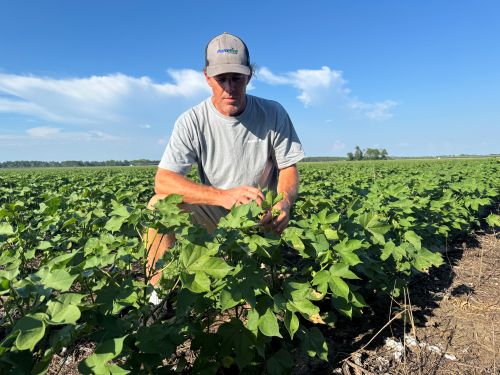
Georgia producer Josh McCormick examines a healthy cotton stand protected by built-in root-knot nematode resistance. McCormick said PhytoGen® brand varieties have help he and his father John produce higher yields while lowering fertilizer rates and decreasing plant populations.
Before planting PhytoGen brand varieties, the McCormicks applied the majority of their fertilizer right after planting hoping to get ahead of the RKN. Now they take a different approach to fertilizer with an 8-way cover crop mix and chicken litter.
In the fall, they plant a cover crop that includes clover, rye, oats and legumes. At planting, they roll down the cover crop and plant directly into it. John said the cover crop helps retain moisture and puts nutrient-rich biomass back into the soil. Chicken litter goes out in March or April before planting, and they apply fertilizer as needed during the season.
“We run on the cover crops and chicken litter until just before bloom, and then we’ll put out some fertilizer to help the crop as it goes into bloom and fruit production,” Josh said. “In the past, we wasted a lot of money chasing fertility because we didn’t have a good root system. With PhytoGen, we’re using less fertilizer and the plant can actually grab hold of what we apply later in the season.”
Saving on Seed
Another major change PhytoGen brand varieties brought to the McCormicks’ farm is a reduction in plant populations. With competitor varieties, they hill dropped 30,000 to 34,000 seed per acre and hoped to get a 60% to 70% stand. Since switching to PhytoGen cottonseed, the McCormicks have drastically lowered their seeding rates because of the exceptional emergence and early seeding vigor.
“PhytoGen has big seed with early season vigor that’s going to come up,” Josh said. “We see 85% to 90% emergence, and that’s coming up in the heavy residue of our rolled cover crop. I like to plant cottonseed fairly deep, and we don’t worry about getting a solid stand with the early season vigor of PhytoGen cottonseed.”
The McCormicks have trialed seeding rates from 14,000 to 30,000 per acre, and they’ve found the best results with singulating 23,000 seed per acre – at a 23% reduction in seed compared to competitive brands.
“We have lowered our seeding rate, saved $15 to $20 per acre, and upped our yield significantly,” Josh said. “It’s also improved our PGR strategy because the plants are farther apart, so they get more airflow and set boll positions down low. That also protects our bolls from the September hurricane rains that we get in the Southeast – that’s a big help with boll rot and to keep up our yield.”
The McCormicks plant most acres to PhytoGen brand PHY 475 W3FE and PHY 545 W3FE, but they’re trialing new varieties to see what’s coming next from PhytoGen cottonseed. They’ll let the data determine which varieties they’ll plant on their farm next season. As always, yield is the No. 1 goal.
“The reason we switched to PhytoGen varieties is for yield. They outyield competitor varieties and make us more money. Once we started growing PhytoGen varieties with the root- knot nematode resistance, we changed up our techniques for how we farm,” Josh said. “We no longer had to worry about root-knot nematodes, so we could focus on other aspects like plant population, fertility, and PGR strategy. All of that has really helped improve our yields.”
™ ® Trademarks of Corteva Agriscience and its affiliated companies. ©2026 Corteva. TSK 27654 BR (08/26) 01559